Great Power Competition: From Bipolarity to Multipolarity
When discussing great power competition, what is actually being examined is the deep struggle for influence between the world’s major powers. For many years, the global scene was dominated by two principal foes in the Cold War, resulting in a bipolar system. The US and Russia were the leading powers on the international stage. However, this is changing. The world is moving toward a multipolar system, where each nation seeks to gain an advantage, continuously reshaping global stability. This article will delve into how great power competition has evolved, revisiting the Cold War and its aftermath, and exploring the complexities of today’s multipolar world. It will also examine how this competition plays out in various arenas.
The Cold War Era
The Cold War era was characterized by two primary sides. The US and the USSR, two superpowers, faced off and shaped global politics. Each side promoted different concepts about how society should operate. The U.S. advocated for capitalism and democracy, while the USSR supported communism and a state-controlled economy. The superpowers established powerful military alliances, such as NATO and the Warsaw Pact.
This competition often led to proxy wars rather than direct confrontation. For example, in the Korean War (1950s), the US fought Soviet-backed factions, and the Vietnam War was another long and bloody conflict. Furthermore, the Cuban Missile Crisis in 1962 brought the US and USSR to the brink of full-scale war. Both sides heavily invested in an arms race, with each seeking to develop more nuclear weapons.
The Transition to Unipolarity
By the 1980s, the USSR was losing its grip on power, and many living within the Soviet Union became frustrated with the authoritarian control over their lives. Leaders like Mikhail Gorbachev attempted reforms, such as glasnost and perestroika, to address some of these issues. However, these reforms ultimately contributed to the collapse of the Soviet Union. By 1991, the USSR dissolved, and the US emerged as the sole dominant power on the global stage.
The US entered a ‘unipolar moment,’ enjoying the most powerful military and the largest economy. It exerted significant influence over numerous global institutions, as analysts like Charles Krauthammer noted.
Despite this unipolar dominance, new trends began to emerge. Other nations began to grow in power. In East Asia, countries like China experienced rapid economic growth. This suggested that the unipolar moment would not last forever, indicating the onset of an evolving international order.
The Rise of Multipolarity
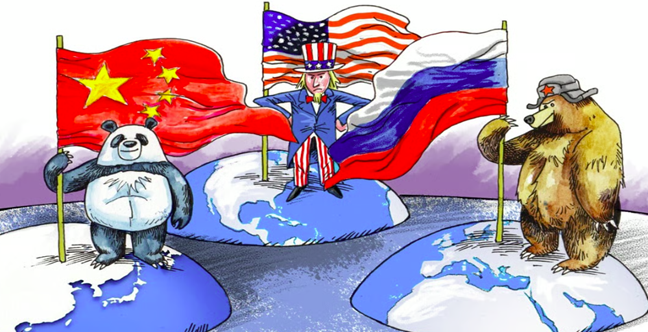
In the current global order, power does not rest with a single country or two. Instead, multiple nations or groups of nations have emerged as influential players. This multipolar system is characterized by fluid alliances, where countries may align on one issue but oppose each other on another. This complexity complicates global politics significantly.
Among the key emerging powers are China, Russia, India, and the European Union. China’s economic growth is unparalleled, and its military capabilities are expanding. Through the Belt and Road Initiative, China is increasing its global influence. Similarly, Russia’s involvement in Syria and its challenge to Western hegemony highlight its rising geopolitical role. India is another emerging power, building new strategic alliances globally. The EU, with its strong economy, continues to shape international rules and remains active in global diplomacy.
Strategic Competition
Economic power plays a central role in today’s geopolitical dynamics. Countries are using money and commerce as tools of influence. Trade wars, tariffs, and control over vital resources and supply chains are common tactics. Additionally, nations are seeking control over global financial systems and currencies to increase their authority.
Military strength remains a key factor in great power competition. Nations are modernizing their militaries and investing in cutting-edge technologies, reshaping the nature of warfare. Sea power, territorial disputes (such as in the South China Sea), cyber warfare, and space militarization all influence modern conflicts.
In addition to economic and military power, there is an ongoing ideological struggle. Countries compete to promote their preferred models of governance. The debate between democracy and autocracy remains central, and the promotion of human rights and universal values is often a point of contention. Nations are striving to influence international laws and institutions to align with their interests, while soft power and narrative control have become increasingly important in global geopolitics.
Way Forward
In this complex world, nations must develop effective strategies to safeguard their interests. A strong economy allows a country to withstand global challenges, while robust diplomatic relations help reduce tensions and prevent conflicts. Effective global institutions will need to adapt to reflect the changing distribution of power, ensuring that they remain relevant in this multipolar world.
Moreover, institutions must reform their structures to mirror the new global order, making them more equitable and efficient. Preventing major wars requires arms control treaties and open communication channels, such as hotlines for leaders, to avoid misunderstandings. Continued cooperation on contested issues and back-channel diplomatic efforts will help build trust and prevent conflicts from escalating.
Conclusion
The evolution of great power competition has transitioned from the Cold War’s clear bipolarity to today’s complicated multipolarity. This competition now spans economic, military, and ideological realms, all of which have significant implications for global stability. The manner in which nations interact will shape the future of international relations. The international system is still evolving, and nations must continue to adjust to new challenges. Strategic thinking and adaptability will be essential for navigating this ongoing journey.